 foxxcyber/docs
The audit binder
One printable record binder per locomotive, and expiring read-only links you can hand an FRA inspector.
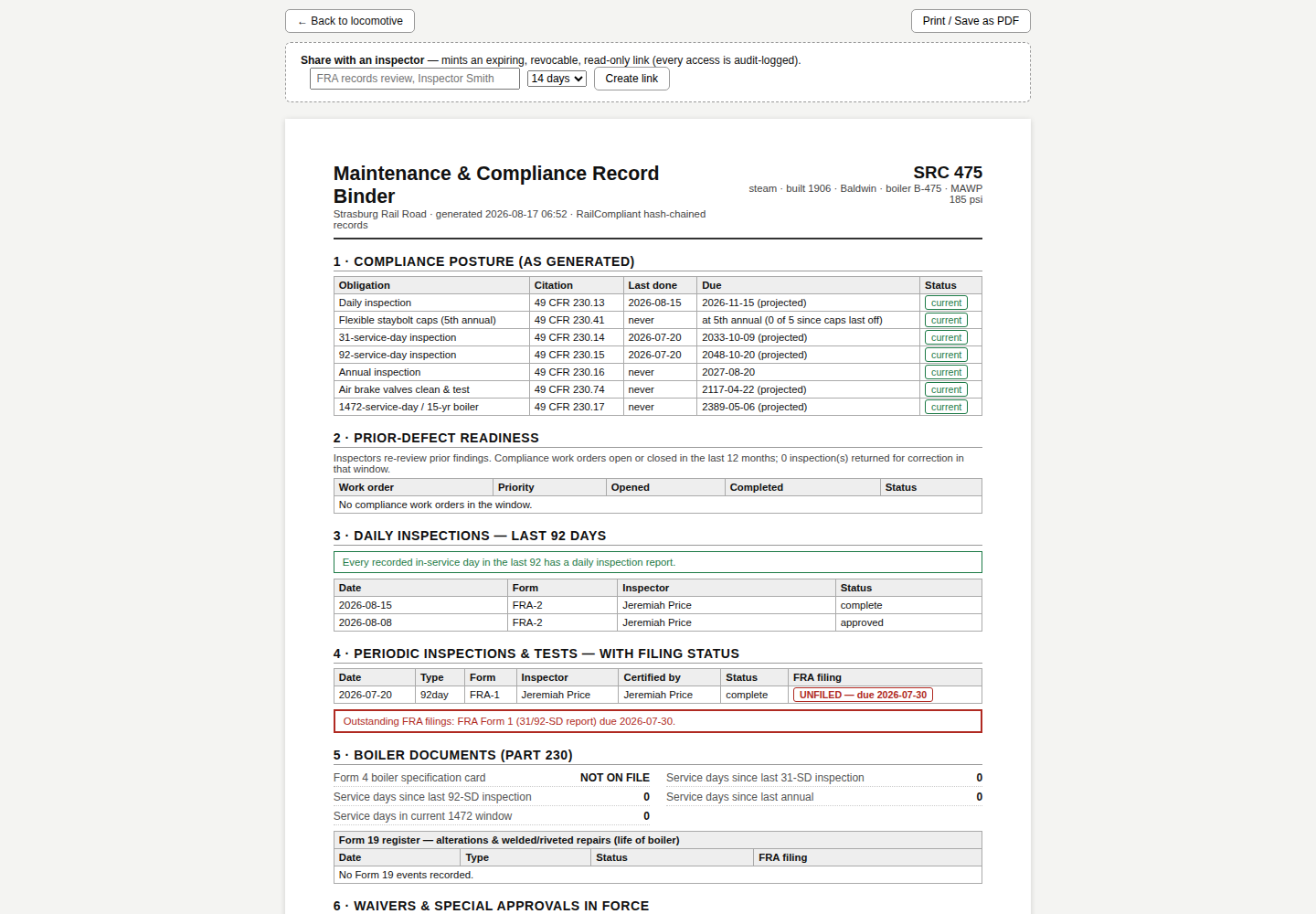
The audit binder is a single printable page, generated per locomotive, holding what an FRA Motive Power & Equipment inspector normally asks to see. Open it from the locomotive's page. The toolbar gives you ← Back to locomotive and Print / Save as PDF; the header states the railroad and the exact time the binder was generated.
What is in it
The binder is laid out in eight numbered sections.
- Compliance posture — every obligation for that locomotive with its citation, when it was last done, when it is due, and its status.
- Prior-defect readiness — inspectors re-review earlier findings. This section lists compliance work orders opened or closed in the last twelve months, and states how many inspections were returned for correction in the same window.
- Daily inspections — last 92 days — the dailies on file, and an explicit count of recorded in-service days that have no daily inspection report against them.
- Periodic inspections & tests — with filing status — the full history with date, type, form, inspector, certifying officer, status, and whether the resulting FRA filing has been closed out.
- Boiler documents (Part 230) — for steam, whether a Form 4 boiler specification card is on file, the running service-day tallies since the last 31-day, 92-day, annual, and 1472 reset, and the Form 19 register of alterations and welded or riveted repairs kept for the life of the boiler.
- Waivers & special approvals in force covering that locomotive.
- Photographic evidence on file.
- Record integrity — a hash-chain verification run at the moment the binder is generated, reporting how many audit records are in the railroad's chain and how many integrity issues were found.
The binder is built not to flatter. Service days without a daily are counted as gaps, forms that have not been filed are labelled UNFILED, and a failed integrity check is reported rather than hidden. A binder that looks clean is evidence; a binder that cannot look worse than the data would be worthless.
The footer notes what the binder does not replace: the in-cab § 229.21 daily record, the cab copy of Form 6180-49A, and Part 230 cab postings of Forms 1 and 3 remain physical documents. It also records that paper copies of any record are available on request, per the fifteen-day expectation in § 229.20(d).
Sharing the binder with an inspector
Rather than exporting files or creating a guest account, an administrator can mint a link that serves the same binder with no sign-in.
- In the Share with an inspector box, type a note identifying the recipient — for example, "FRA records review, Inspector Smith".
- Choose how long the link should last: 14 days, 30 days, or 90 days.
- Click Create link.
The link is then displayed once, with the message that you should copy it now because it is shown only once and stored hashed. RailCompliant keeps only a fingerprint of the token, so a lost link cannot be recovered — mint a new one instead.
Existing links are listed underneath with their Note, Expires date, how many times they have been used, and when they were last used. Revoke kills a link immediately.
Anyone opening the link sees the binder marked Read-only inspector view · shared by your railroad, with no navigation into the rest of the application. Every access is recorded in your railroad's record history along with the address it came from.