 foxxcyber/docs
Waivers & special approvals
Keep the FRA relief your railroad operates under on file, with renewal deadlines worked out backwards from expiry.
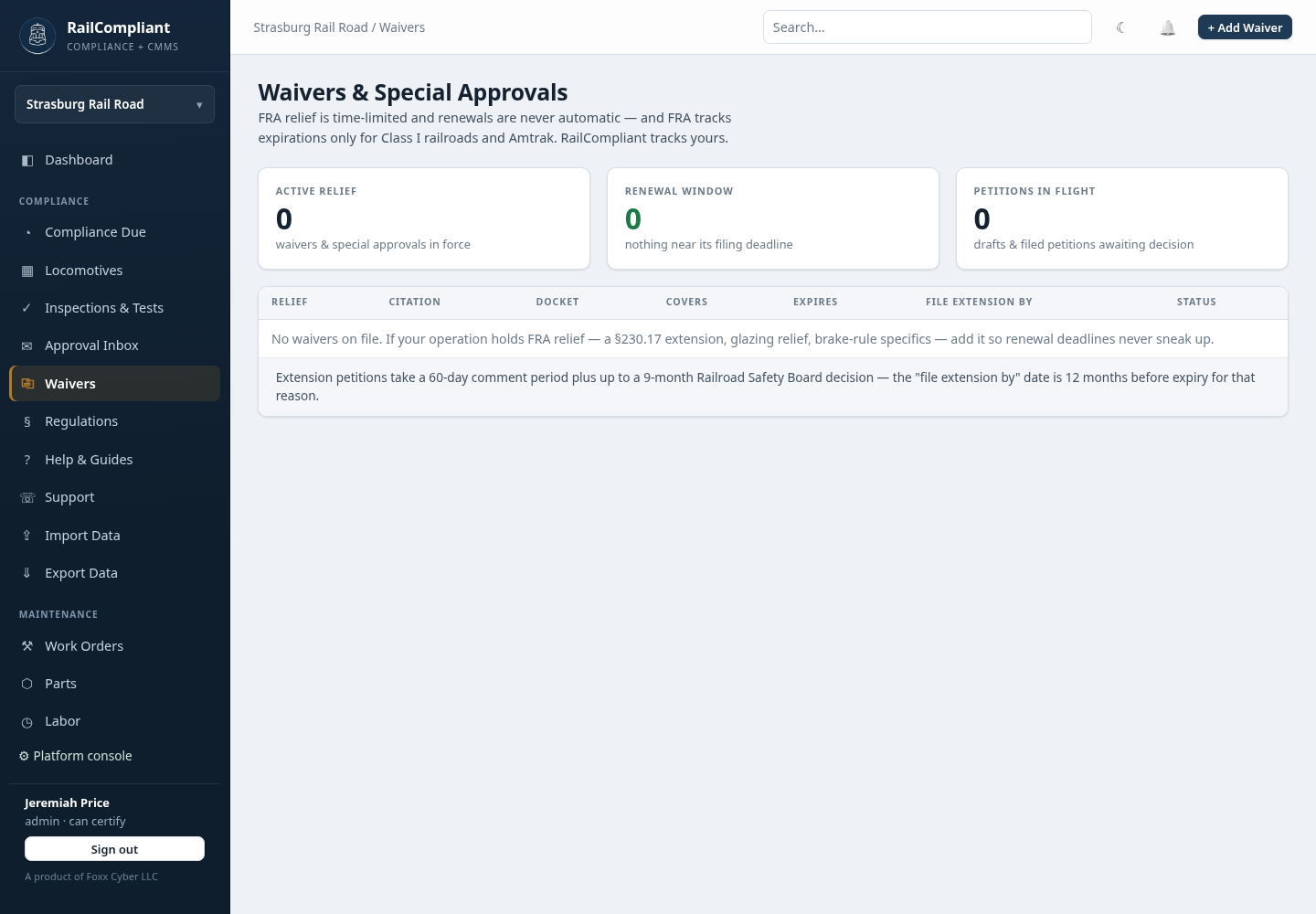
FRA relief is time-limited and renewals are never automatic. The Waivers page is the register of every waiver and special approval your railroad operates under — a § 230.17 extension, glazing relief, a brake-rule specific — so that a renewal deadline never arrives unannounced.
The register
The page opens with three counts: Active relief (waivers and special approvals in force), Renewal window (anything near its filing deadline), and Petitions in flight (drafts and filed petitions awaiting decision).
The table below lists each entry by Relief, Citation, Docket, Covers, Expires, File extension by, and Status. Docket numbers link out to the public docket on regulations.gov, which is the FRA's system of record.
Adding an entry
Click + Add Waiver. Record the relief exactly as granted:
- Title and CFR citation.
- Kind — Waiver (Part 211) or Special approval (in-rule).
- Status —
draft_petition,filed,active,expired,denied, orsuperseded. - Docket number as it appears on regulations.gov, and a Decision document URL or reference.
- Granted on, Expires on, and Petition filed on for an extension still in flight.
- Scope — territory, speed limits, equipment class.
- Conditions — copy these verbatim from the grant letter. Inspectors check compliance with the conditions, not just the existence of the waiver.
- Notes.
- Covered locomotives — tick the locomotives the relief applies to. Leaving every box unticked means the relief is railroad-wide.
Click Add to registry to save.
The filing deadline, not the expiry
The column that does the real work is File extension by, and it is not the expiry date. An extension petition needs a 60-day comment period, and the Railroad Safety Board can take up to nine months to decide. RailCompliant therefore works backwards and puts the recommended filing deadline twelve months before expiry — and flags rows due soon and overdue against that date rather than against the expiry.
The FRA tracks waiver expirations only for Class I railroads and Amtrak. For everyone else, watching the clock is the railroad's own job — which is what this register is for.
Reminders
Administrators are reminded as expiry approaches, at fifteen, twelve, nine, six, three, and one month out. Inside six months the reminder escalates in severity and its wording changes: by that point the extension should already be filed, and relief that lapses cannot be assumed back. See Notifications for how to control where these arrive.
Where relief shows up elsewhere
Active waivers appear on the page of each locomotive they cover, and in section 6 of that locomotive's audit binder — so an inspector reviewing the binder sees the relief alongside the records it applies to, without you having to assemble anything.